Come visit us at our new location! 13433 West Highway 72 in Hiwasse Arkansas

Close
×

Would you like to switch to the accessible version of this site?

Go to accessible site Close modal window

Don't need the accessible version of this site?

Hide the accessibility button Close modal window
Accessibility View Close toolbar

(479) 855-9944

BELLA VISTA ANIMAL HOSPITAL

Bella Vista

Animal Hospital

Menu
  • Home
  • New Patient Center
    • Online Forms
    • What To Expect
    • Veterinary Resources
    • Payment Options
  • Services
  • About Us
    • Meet Our Team
    • Tour
  • Employment
  • Testimonials
  • Contact Us
    • Appointment Request
  • Pet Selector
  • Blog
  • Veterinary Topics
    • Pet Health
      • Chronic Conditions
      • Digestive and Oral Health
      • Diseases and Viruses
      • Pests and Parasites
      • Orthopedics
    • Today's Veterinarian
    • Choosing Your Pet
      • Finding Your Pet
      • Cats
      • Dogs
      • Horses
      • Exotics
        • Amphibians
        • Birds
        • Reptiles
          • Lizards
          • Turtles
      • Small Mammals
        • Ferrets
        • Rabbits
        • Domesticated Animals
          • Prairie Dogs
        • Pocket Pets
          • Chinchillas
          • Guinea Pigs
          • Hamsters
          • Hedgehogs
          • Rats
      • Livestock
        • Cows
        • Donkeys, Horses & Mules
        • Goats
        • Pigs
        • Poultry
        • Sheep
    • Living With Your Pet
      • Bringing Your Pet Home
      • Children and Pets
      • Providing Care
      • Travel
      • Saying Goodbye
    • Newsletter Library
      • Cats
      • Tips for Pet Owners
      • Behavior & Training
      • Fleas & Parasites
      • Keeping Pets Healthy
      • Equine
      • Recognizing Illness
      • Nutrition & Food
      • Pet Dangers
      • Seasonal Topics
      • Visiting the Vet
      • Newsletter Archive
        • Fun with Pets
        • Unbelievable Pets
    • Video Newsroom
      • Health Topics
      • Technology and Science
      • Other Interests
    • Newsletter Library
    • Client Survey
    • Pets4Kids
    • Equine
  • Home >
  • Articles >
  • Equine >
  • Pet Health >
  • Orthopedics >
  • Bucked Shins

Bucked Shins

  • Created in Equine, Pet Health, Orthopedics

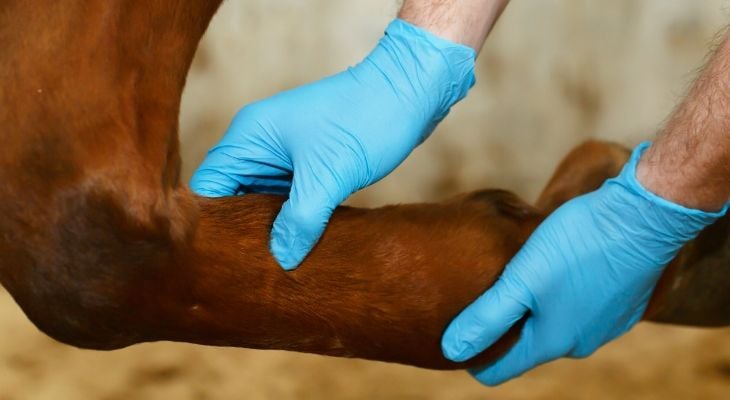
vet examining horses leg
Bucked shins is the common name for very small fractures on the front part (periosteum) of a horse’s cannon bones. These bones are on the lower part of the leg, and run between the knee and the fetlock joint below.

Symptoms of Bucked Shins

Bucked shins are more common in 2- to 3-year-old Thoroughbreds that are just starting to train or race. It is estimated that up to 70 percent of these horses have bucked shins. This condition is less common in Quarter horses and Standardbreds.

Very small fractures (microfractures) of the cannon bone can develop when a horse trains at high speeds before the bones are ready. This puts more stress on the bone than it is able to withstand. More gradual training, however, can allow the bones to adapt to that stress and grow stronger.

The most common symptoms of bucked shins are:

  • Pain when the front of the cannon bone is touched
  • Warm swelling in the area of the cannon bone, starting as soft and then becoming hard later on
  • Lameness and a shorter stride, with the lameness growing worse with exercise

A veterinarian may take an X-ray of the horse’s leg to confirm the diagnosis and rule out other problems in the bone.

Treatment for Bucked Shins

Treatment for bucked shins usually involves a combination of rest and medication to reduce the inflammation. Cold packs may also be used to reduce the symptoms. This is continued until the soreness and inflammation resolve.

Training of the horse can resume once the most severe lameness and pain has gone away; although, it will need to be done at a slower pace. Sometimes a horse may continue to have a hard, bony swelling (“bucked shin”) on the front of the cannon bone. This should not affect how well the horse races in the future.

Bucked shins may also be a sign of more serious stress fractures. These might need to be fixed with screws inserted into the bone to stabilize the fracture. It is always advisable to consult with your veterinarian for a proper diagnosis and treatment.

  • Pet Health
    • Chronic Conditions
    • Digestive and Oral Health
    • Diseases and Viruses
    • Pests and Parasites
    • Orthopedics
  • Today's Veterinarian
  • Choosing Your Pet
    • Finding Your Pet
    • Cats
    • Dogs
    • Horses
    • Exotics
      • Amphibians
      • Birds
      • Reptiles
        • Lizards
        • Turtles
    • Small Mammals
      • Ferrets
      • Rabbits
      • Domesticated Animals
        • Prairie Dogs
      • Pocket Pets
        • Chinchillas
        • Guinea Pigs
        • Hamsters
        • Hedgehogs
        • Rats
    • Livestock
      • Cows
      • Donkeys, Horses & Mules
      • Goats
      • Pigs
      • Poultry
      • Sheep
  • Living With Your Pet
    • Bringing Your Pet Home
    • Children and Pets
    • Providing Care
    • Travel
    • Saying Goodbye
  • Newsletter Library
    • Cats
    • Tips for Pet Owners
    • Behavior & Training
    • Fleas & Parasites
    • Keeping Pets Healthy
    • Equine
    • Recognizing Illness
    • Nutrition & Food
    • Pet Dangers
    • Seasonal Topics
    • Visiting the Vet
    • Newsletter Archive
      • Fun with Pets
      • Unbelievable Pets
  • Video Newsroom
    • Health Topics
    • Technology and Science
    • Other Interests
  • Newsletter Library
  • Client Survey
  • Pets4Kids
  • Equine

NEW PATIENTS RECEIVE $20 OFF FIRST EXAM

Fill out and submit information below to print offer

Office Hours

Main Office

Monday:

7:00 am-6:00 pm

Tuesday:

7:00 am-6:00 pm

Wednesday:

7:00 am-6:00 pm

Thursday:

7:00 am-6:00 pm

Friday:

7:00 am-6:00 pm

Saturday:

Closed

Sunday:

Closed

Our Locations

new

new
  • Copyright © 2026 MH Sub I, LLC dba iMatrix.
  • Admin Log In